Founder-led sales
Test a narrow ICP thesis with a small cohort, explicit exclusions, and a clear reason each account belongs.
Use cases
Configure the agent around the decision being made—not a generic promise of more leads—then align output depth, review ownership, and connector scope to the team using it.
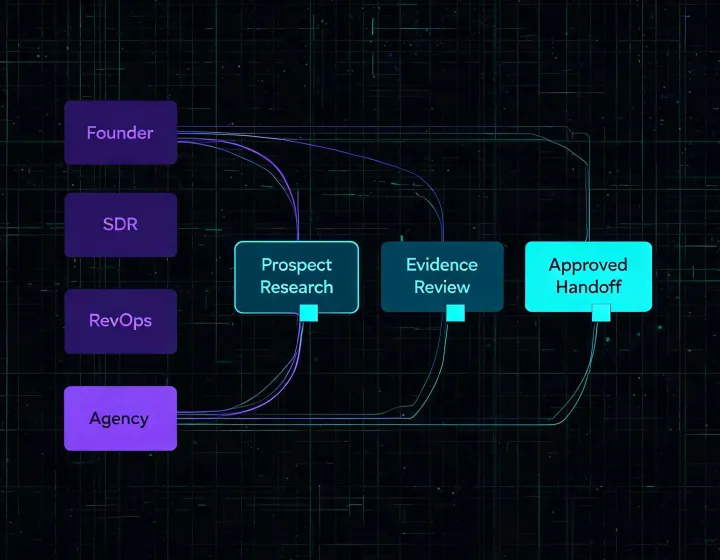
Operating contexts
Test a narrow ICP thesis with a small cohort, explicit exclusions, and a clear reason each account belongs.
Prepare account and role context so reps spend review time on relevance instead of repetitive tab switching.
Evaluate enrichment candidates against field rules, provenance requirements, and CRM writeback controls.
Connect a bounded agent task to approved data services and downstream systems through observable interfaces.
Research account signals for campaign segmentation without presenting inference as confirmed buying intent.
Separate client briefs, credentials, suppression policies, and review queues across managed workspaces.
Compare workflow cost, operator time, and output quality without relying on seat count as the only measure.
Inspect package behavior, secrets handling, connector scope, data retention, and deletion responsibilities.
Evaluation matrix
| Team | Primary input | Review gate | Useful output |
|---|---|---|---|
| Founder | Market thesis | Problem relevance | Small learning cohort |
| SDR | Territory brief | Account and role fit | Prioritized queue |
| RevOps | Field contract | Source and confidence | Approved enrichment file |
| GTM engineer | Task schema | Permission boundary | Observable workflow |
| Agency | Client policy | Workspace isolation | Client-specific review set |
Agent-native execution reduces context switching and can avoid adding another seat-based interface, but it places more responsibility on runtime configuration and operator discipline. A managed SaaS interface may centralize permissions and reporting, while a local agent workflow can make execution steps easier to inspect. Neither model is universally safer or less expensive.
Waterfall enrichment can increase the chance of finding a candidate value, yet each additional source introduces its own freshness, rights, and confidence questions. A single-source approach is easier to explain but may leave more fields unresolved. Evaluate provenance and acceptance rules instead of treating match rate as proof of correctness.
Browser automation can reproduce tasks that lack an API, though selectors, provider terms, and session behavior may change. APIs usually offer clearer contracts and rate limits, but their field coverage may be narrower. Keep external actions behind human approval and test failures as carefully as successful paths.
Install the skill, define a bounded brief, and validate its first result before expanding scope.